





GTM HQ helps Series A through C AI and B2B software companies globally build a predictable pipeline of Fortune 500 and enterprise opportunities through motion clarity, buyer mapping, and senior-led account intelligence.



































You've hired SDRs. You've bought Outreach and Apollo. You've run ABM campaigns. You've sponsored conferences. You've worked through your investors' warm introductions. You've followed the CRO playbook from your last B2B SaaS company.
The pipeline still doesn't compound.
The forecast is theater. The pipeline is a list of hopes attached to names. The board meeting is a recitation of activity, not a read on the business.
You don't have a GTM problem. You have a motion problem you haven't named yet.

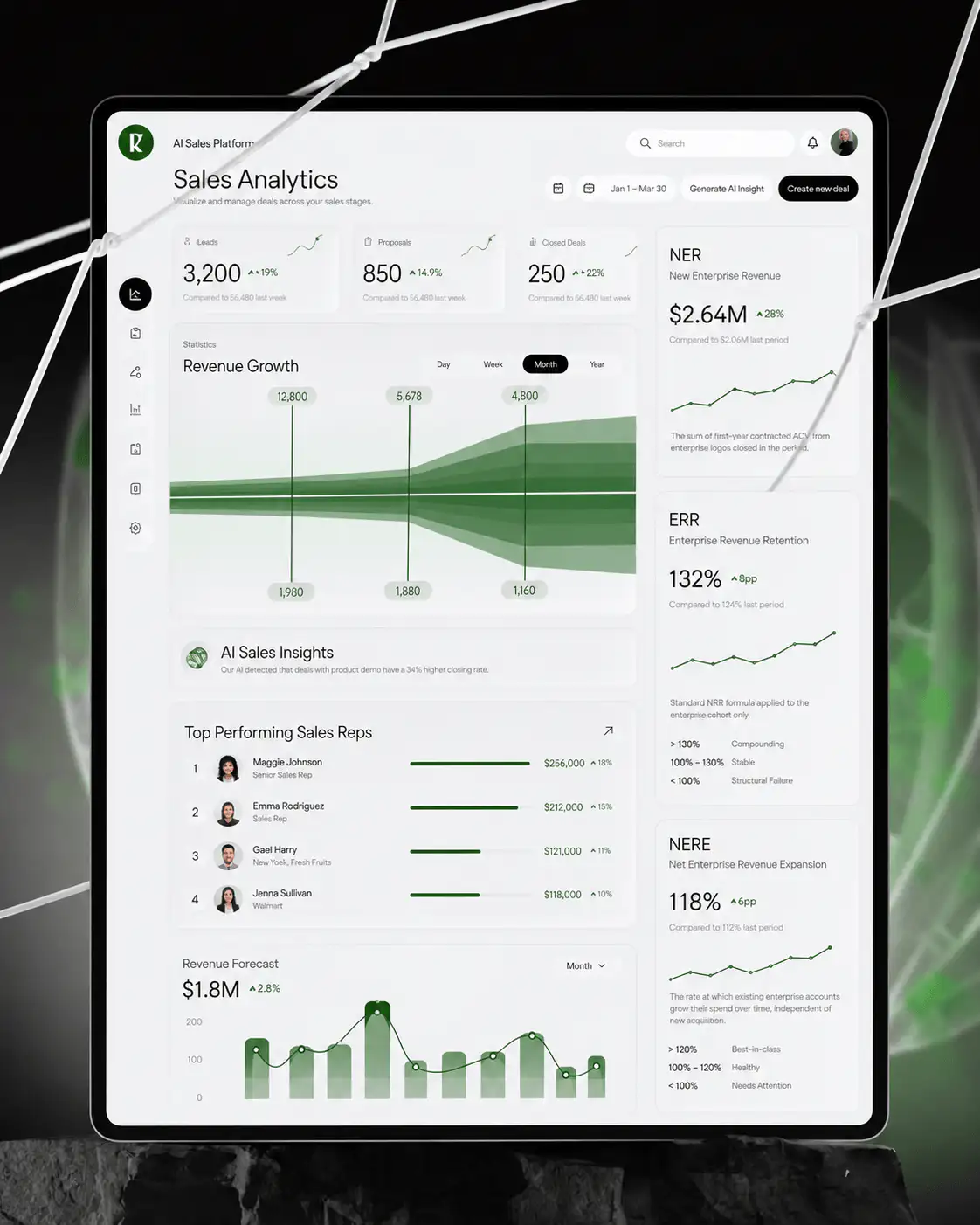
Account selection, account intelligence, and senior-led motion coaching, the three layers of work that turn a named-account list into closed enterprise revenue.
Most enterprise GTM programs treat these as three separate problems handled by three separate teams. RevOps builds the target list. SDRs and AEs research the accounts. Sales leadership coaches the deals. The work is fragmented across functions, the artifacts don't talk to each other, and the senior conversations land without the depth the buying committee expects.
We run the three layers as one system. The list informs the intelligence. The intelligence shapes the motion. The motion is coached at the altitude the enterprise actually buys at. Each layer compounds on the one before it, and senior time gets spent where it changes the outcome.
Here's how the three layers work.
LAYER 1: KNOW YOUR MOTION

Most founders cannot tell you what motion they are actually running. They can tell you what they intended. What is actually closing deals is a different question. We run your closed-won and closed-lost deals through the 52-motion taxonomy, account by account. The motions quietly closing your deals get named. The motions consuming effort without producing revenue get named too.


The companies that scale fastest run a coherent stack of two or three motions, anchored to one of four archetypes : Wedge, Beacon, Operator, or Cathedral. We map your current stack against the archetype that fits your ICP, ACV, and stage. The output is a written read on which motions to add, retire, and double down on. Without motion clarity, the pipeline is noise.
LAYER 2: MAP MOTION TO BUYER

A motion that works for one buyer does not work for another. Selling AI to a Chief AI Officer is not selling AI to a CIO. We map the actual buyer center for your top 20 enterprise accounts — economic buyer, technical buyer, operational buyer, risk gate, initiator, blocker. Most teams are selling to a buying committee that no longer exists.

Where the motion and buyer center align, deals close. Where they do not, deals die in procurement and nobody can tell you why. We run this alongside frameworks like Sangram Vajre's MOVE and Jacco van der Kooij's bow-tie , they tell you the structure, we tell you which motion fits which buyer inside it. Without buyer-motion alignment, deals die for reasons your team cannot diagnose.
LAYER 3: SCALE WITH SIGNAL
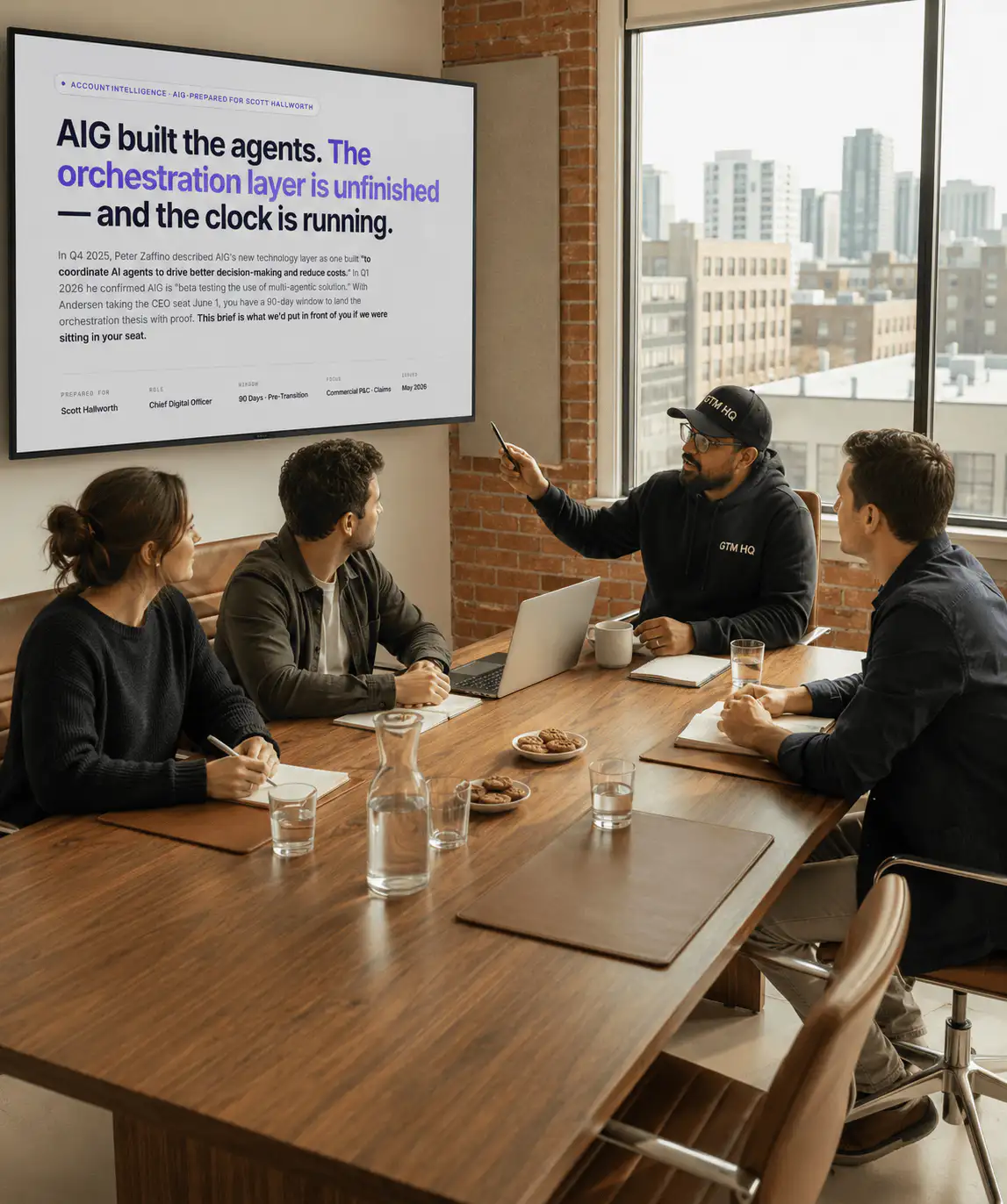
For your top 20 to 60 named accounts, we produce the Signal — a nine-section intelligence brief built for each one. The thesis. What they've built. The unfinished layer. The challenges their team is wrestling with. The three bets we'd ship first. The buyer center as it actually exists. Sourced to the public record. Not a research dump. The artifact that makes the next senior conversation possible. The CDO sees her own roadmap reflected back, with the gaps named.

Even with the right motion and intelligence, enterprise deals stall in places no playbook anticipates. The champion goes quiet. The CFO asks a question that breaks your commercial model. We coach your team through the senior conversations and join the call when judgment is needed in the room. Without senior-led coaching, even a clean motion fails at the final conversation.
You don't know your motion. That's because there are 52 of them.
Enterprise go-to-market is not a single motion. It is a taxonomy of 52 distinct motions, organized across four archetypes. We mapped them in the most exhaustive published taxonomy of enterprise GTM motions for the AI era.

Self-serve with institutional evidence.
Brand-first, anchored with credible enterprise references, scaled through tech-company cohorts.
Examples: Glean. Writer. Notion.

Self-serve with product evidence.
Developer-led, individual paid tier expanding into the enterprise SKU.
Examples: Cursor. Vercel. LangChain. Replit.

High-touch with institutional evidence.
Analyst-led, SI-partnered, intellectual-brand-anchored.
Examples: Cohere. Mistral. Anthropic.

High-touch with product evidence.
Forward-deployed engineering, paid pilots, outcome-based commercial structure.
Examples: Sierra. Decagon. Cresta. Harvey. Hippocratic AI.
Your motion stack depends on five variables: your ICP, your average contract value, your stage, your team composition, and your category maturity. Most companies are running the motion of their last company instead of the motion their current company needs.
Most companies selling into the enterprise are running a motion built for a different market. The cadences come from SaaS volume playbooks. The automation comes from tools built for SMB conversion. The metrics come from a funnel designed to convert leads at scale. None of it survives contact with an enterprise buying committee.
You're thinking it. But producing the work that earns substantive conversations at named enterprise accounts requires a discipline most teams don't have, and most alternatives are not built for. Here is the honest read on what each option actually produces.

Four phases. One geometry. Every named account bends through the same arc — from selection, to read, to case, to synthesis. ARCS is how we build the work that makes enterprise GTM native to how enterprises actually buy.
Refine the ICP and pick the accounts worth your team's quarter
We start with a deep alignment session. A senior enterprise GTM operator works with you on the ICP — by vertical, by trigger, by procurement profile, by deal shape. Then we pick the 20 to 60 named accounts the engagement will cover. We exclude what is already in pipeline, what your CSMs are expanding, and the structural impossibles. What remains is the target list your team can win against.
Timeline: Days 1-10

Read each account the way its own team reads it
For every named account, we go deep on public sources. Earnings transcripts. SEC filings. Executive commentary. Board moves. Regulatory disclosures. Partnership announcements. Recent hires and what they signal. The CEO's public commitments. The CIO's tech stack disclosures. The CISO's compliance posture. The CFO's budget commentary. Fifty to sixty sources cross-referenced per account. The output is a structured signal inventory that feeds the Case phase.
Timeline: Days 10-30

Build the case the buying committee would have built themselves
For each named account, we produce the intelligence package — the Signal, the buyer center map, the champion identification, the outreach sequences, the human layer. Each package is built so that when the named buyer opens it, the buying committee inside the account recognizes their own roadmap reflected back. The Signal is hosted on a page under your domain. The sequences go to your sales team. The packages become the working surface for every conversation.
Timeline: 30-60

Coach the team, refine the motion, hand off the playbook
Your sales team deploys the packages. We coach the stack. We review the replies that matter. We prep your AEs for every senior conversation. We refine the approach based on what is landing and what is not. By Day 90, your team owns the playbook — the intelligence layer is a capability your company carries into the next quarter without us in the room.
Timeline: Days 60-90

Strategic insights on scaling enterprise GTM that drives core business results
Sharp daily takes on AI news — the great, good, and bad through an enterprise GTM lens.








.svg)


